Thursday, 5 January 2017

Smile [1975]

SMILE is an American satirical comedy that was produced and directed by Michael Ritchie and originally released in July 1975 by United Artists.  It stars Bruce Dern, Barbara Feldon, Annette O’Toole, Joan Prather and Geoffrey Lewis.  It centres on the preparations for and staging of a Californian beauty pageant, intertwined with the domestic lives of those involved.


It’s easy to forget now that the Miss World beauty contest was huge business back in the day, being an annual live broadcast on the scale of major sporting events.  Here in the UK it disappeared from TV screens back in the 1980s (although has been intermittently revived on smaller channels) because of the unstoppable tide of public opinion against the sleaziness and sexism  and vacuousness of it all.  As such, the beauty pageant is the perfect vehicle for examining broader themes about modern life and popular culture and that’s exactly what Michael Ritchie did in SMILE.

If I could sum up the film’s premise in one word it would ‘exploitation’.  Everyone’s at it; the scale is breathtaking.  From the contestant looking to win favour with the judges by emphasising that she grew up without a father; to the head judge’s son who is looking to make a few bucks selling nude photos of the girls; to the “Hollywood” professional choreographer who would rather ruin the girls routines than give up $500.  And the girls are being exploited by everybody.  But as long as you keep smiling there’s no limit to what you can try to get away with.


Similarly, most of those involved – and seemingly the entire population of Santa Rosa is involved – define themselves by the annual pageant.  Second-hand car dealer ‘Big Bob’ Freelander (Dern) is honoured to be head judge; chief fixer Brenda (Feldon), a past winner, has devoted her life, not to say her entire persona, to the contest; producer Wilson Shears (Lewis) is determined to bring the event in on budget, even if it puts the girls in danger.  Of course there are the girsl themselves and, ironically, it is they who, in general, seem the least invested in the enterprise.  They want to win, certainly, but some of them seem half-hearted about it, probably because the Young American Miss contest is but one of many they enter.

Big Bob reacts badly when Andy tells him he IS a Young American Miss.


What Ritchie’s focuses on above all is the staggering importance with which the event is invested by those caught up in it.  He shows us not simply that the pageant is nothing more than superficial entertainment but that even though that’s all it is, it nevertheless draws remarkable energy and emotion from the participants.  It isn’t until Big Bob starts quoting from the pageant programme, believing it to be a sound philosophy of life (“All it takes is a drop more perseverance, a drop more optimism and a drop more energy!”) that his alcoholic friend Andy (husband of Brenda) tells him that “I finally figured out what you are.  You know what you are?  A goddamn Young American Miss!”

The crucial point about SMILE is that Michael Ritchie is not satirising the concept of the beauty pageant but rather how such a concept can stand as a reflection of society more broadly.  The superficiality – the primacy of the first impression, the way something looks being a measure of its quality; the way glib statements that are staggering in their vapidity can actually influence the way others think of you (“I want to be a veterinarian… or a nun.”); and the way any endeavour – even one as a meaningless as a beauty pageant – can be reduced to a money-making exercise.  On this last point, there is a profound exchange between Robin (Prather) and Doria (O’Toole):

“Boys get money and scolarships for making a lot of touchdowns; why shouldn’t a girl get one for being cut and charming?”

“Yeah… but maybe boys shouldn’t be getting money for making touchdowns.”

Joan Prather (L) as Robin and Annette O'Toole (R) as Doria, discussing how to earn big bucks


The only character who exhibits any sort of awareness of reality is Andy and he has been reduced to alcoholism by that awareness – which he has acquired via his monstrous wife, who has a portrait of herself over their fireplace.  At one point he shoots her, causing a superficial (naturally) wound to her shoulder but feels safe in the knowledge that she would never press charges and bring scandal to the pageant.  While in temporary custody he confides to Big Bob that he feels pretty damn good and wants to leave Santa Rosa.

Michael Ritchie at work
SMILE is not unlike Ritchie’s earlier film THE CANDIDATE which presents a similarly jaundiced view of American life in its depiction of an election campaign.  From the late 60s to the end of the 1970s  Ritchie turned out a series of pictures in various genres which display a remarkable level of consistency.  They were also properly adult pictures in the sense that they were for intelligent, grown up people.  Unfortunately, all that came crashing down in 1980 when he made THE ISLAND, an adaptation of golden boy Peter Benchley’s novel about pirates in the modern day Carribbean.  It was a critical and commercial disaster and while Ritchie continued to work regularly, his glory days were over.  He had another 17 years of his career to run but in that time only FLETCH [1985] and DIGGSTOWN [1992] were any cop.

Bruce Dern as Big Bob Freelander


SMILE is an ensemble piece so it’s not possible to comment on star performances.  The biggest name actor involved is Bruce Dern who was cast so often as misfits, weirdos and downright psychopaths that to see him in a relatively straight role is something of a rarity.  He’s an oily character here, a man who believes his own hype and chases success for its own sake.  He has a dark night of the soul after Andy confronts him about his shallowness but, by the time the film ends, we see him back to his ‘best’, flogging recreational vehicles and handing out balloons.

Geoffrey Lewis as Wilson Shears


Geoffrey Lewis is another character actor who specialises in oddballs and it’s hard to separate that from his character here, even though, like Dern, he plays a relatively normal guy.  I kept expecting him to wipe his nose on the back of his sleeve, so many times have I seen him play dumbasses in overalls.  I gather Barbara Feldon was a big TV star Stateside in GET SMART but since I’ve never seen that show I can’t reall comment on her career; suffice it to say she plays the awesomely efficient Brenda very well.  The two standout beauty contestants are Joan Prather, who again I know nothing about, and Annette O’Toole, who I do.  

Annette O'Toole (C) and Joan Prather (R)


The latter always struck me as someone who should have been a huge star but success on that level eluded her.  It’s a shame because she’s terrific here and a memorable presence in a couple of other good movies, Walter Hill’s 48 HRS [1982], a massive hit in its day but not a film you hear much about recently, and Paul Schrader’s CAT PEOPLE [1982], a remake of the Val Lewton / Jacques Tourneur horror picture which eschews the subtley and shade of the original in favour of wild explicitness.  Also worth a mention are Melanie Griffith (whom you can see in the title picture at the top of this article, on the right) as a fellow contestant and Dennis Dugan, the unlikely hero of Joe Dante's THE HOWLING [1981].


Behind the camera was Conrad Hall who shot a tremendous number of tremendous US films in the 60s and 70s.  When he was making ELECTRA GLIDE IN BLUE in 1973 he apparently argued so strongly with director James William Guercio about how the film should look that they agreed Hall would shoot the interiors and Guercio the exteriors, which says something about the art of compromise.  As you might expect, Guercio did a terrific job of shooting the impossibly photogenic Monument Valley while, somewhat surprisingly, the interiors are all rather dark.

Saturday, 27 August 2016

Nijinsky [1980]

NIJINSKY is an American biographical drama that was directed by Herbert Ross and originally released in March 1980.  It stars Alan Bates, George De La Pena, Alan Badel and Leslie Browne.  Not to be confused with the racehorse, Vaslav Nijinsky was a Ukrainian ballet dancer, world famous in the early part of the 20th century.  His continued renown is of course mainly due to his genius although his name has, since his death in 1950, become something of a byword for the unstable, tortured genius.  This film concentrates on Nijinsky's professional and romantic relationship with Sergei Diaghilev, the impresario manager of the Ballets Russes of which Nijinsky was a member.  Specifically, it concentrates on the breakdown of this relationship as Nijinsky becomes involved with Romola de Pulszky, a Hungarian aristocrat obsessed with the young dancer.


It struck me afterwards that this film, like many on a similar theme of forbidden (for which read ' homosexual') love, is destined to end in tragedy, almost literally from the first frame which show a start-jacketed Nijinsky slumped on the floor of an asylum cell.  As Alex Cox once remarked, it is in the nature of Hollywood to encourage white middle-class people to marry and have babies, so it is possible to read into the industry's fondness for homosexual relationship coming to a sad end a subtle condemnation.  However, unlike many similar films of this type, this one shows us that Nijinsky's fate comes about because he, momentarily, rejects the homosexual side of his nature.

Diaghilev and Nijinsky
 The villain of the piece, if one can describe her as such, is Romola.  The book claims to be based on her memoirs and her (heavily edited) volume of her husband's memoirs, so for her to come out it of as the bad egg is remarkable.  However, she died in 1978, probably around the time that this project was getting off the ground, and therefore was not around to condemn the film's portrayal of her.  I'll confess I haven't read her books but I understand they tend to, by turns, emphasise and de-emphasise aspects of Nijinsky's life to burnish his legend.  One particular example is her husband's homosexuality.  Be that as it may, in Ross's film she is the femme fatale who leads Nijinsky away from his great love and dooms him.

Romola first sets eyes on her obsession
The 'normalisation' of the gay relationship is continued in the film's aesthetic: the presentation is tasteful (perhaps too tasteful for some), the settings sophisticated, the atmosphere rarefied.  In other words, the film depicts the relationship in the same terms it would present a straight period romance.  It eschews the idea that such things must be presented against a background of searing realism, as for instance in VICTIM [1961], NIGHTHAWKS [1978] and even MY BEAUTIFUL LAUNDRETTE [1985].

In this film, Nijinsky, Diaghilev, the Baron de Gunzburg (wealthy sponsor of the Ballets Russes), indeed all the other homosexual characters, appear to be entirely comfortable in their sexuality and unashamed.  As Diaghilev says to his lover, "We are what we are and we should never forget it."  Ross makes a point of placing this exchange during a brief holiday sequence, the two take to Greece in 1912, encouraging the audience to see their relationship in the context of the ancient Greek model.

Nijinsky and Diaghilev in Greece
In actual fact, the reason Diaghilev and Nijinsky are doomed is not the intrusion of Romola de Pulszky into their relationship but the blind infatuation Nijinsky provokes in them both and the extent to which that infatuation leads the infatuated into exploiting the object of their obsessive love.  Diaghilev allows / encourages Nijinsky to begin choreographing some of his productions which not only provokes the wrath of the critics but also alienates the company's existing choreographer Mikhail Fokine and the composer Stravinsky.  More than that though it places Nijinsky himself under enormous pressure which leads to his eventual breakdown.

Nijinsky nears mental collapse while devising the choreogrpahy for Stravinsky's 'Rite of Spring'
As a dramatic story, the film has everything - love, pain, art, madness, joy, jealousy, triumph, failure - and as such it is terrifically watchable.  Two or three weak performances are compensated for by having a number of smaller roles played by fine, experienced actors and by Alan Bates's superb central performance as Diaghilev.  Obviously the roles of Nijinsky, Romola (who willed herself into becoming a Ballets Russes ballerina simply to be near the object of her obsession) and Tamara Karsavina, the prima ballerina, had to be filled by professional dancers who would perforce not primarily be actors.  The respective actors George De La Pena, Leslie Browne and Carla Fracci are okay but not outstanding which is why, apart from Bates, director Ross offers us the likes of Alan Badel, Ronald Pickup, Janet Suzman, Sian Phillips, Colin Blakely and Ronald Lacey.

Alan Bates as Sergei Diaghilev (in a still reminiscent of Sir Dirk Bogarde in DEATH IN VENICE)

I've written about Bates elsewhere (specifically in my review of A DAY IN THE DEATH OF JOE EGG, which you can read here) but I can only reiterate that he is one of my favourite actors.  I remember the grand old curmudgeon of film writers Leslie Halliwell said of him something like 'tends to play thoughtful toughs with soft centres' and it's basically true.  Bates had the face and physique of a Hollywood leading man, all brooding dark good looks, but, like Richard Burton, he was essentially a more theatrical actor and in my opinion was at his best in adaptations of plays and novels.  For example, apart from the aforementioned JOE EGG, his best performances I reckon are in BUTLEY [1974], IN CELEBRATION [1975] and THE GO-BETWEEN [1970].  It's no coincidence that he is in three of the excellent American Film Theatre series, film versions of outstanding theatre productions.

Alan Bates in ZORBA THE GREEK from 1964
Bates was a bisexual man who was married and had children but who also had several long term relationship with men.  I understand that he always denied to himself and to them that he was gay, which seems to me to be a pretty odd claim to make, and he was reticent about discussing his private life in the media.  One has to appreciate that men of his generation (he was born in 1934) lived the formative years of their life in a Britain in which homosexual acts were a criminal offence.  Many men went to their graves without admitting publicly that they were gay - Kenneth Williams and Sir Dirk Bogarde are two examples.  Furthermore, Bates was highly attractive to women and, as a professional actor, was keen to promote that image of himself.

Bates (L) and Oliver Reed (R) in WOMEN IN LOVE from 1969
However, Bates was drawn to characters with a homosexual side.  Diaghilev is an obvious example but there are many others: Rupert Birkin in Ken Russell's WOMEN IN LOVE [1969], with its notorious nude wrestling scene; Ben Butley in BUTLEY; Guy Burgess in AN ENGLISHMAN ABROAD [1983]; Frank Meadows in WE THINK THE WORLD OF YOU [1988] and even Sir Hugo Coal in the dreadful THE GROTESQUE [1995].  I'm hard pressed to think of any overtly gay roles played by Bates's contemporaries like Richard Harris or Albert Finney or Peter O'Toole or Sean Connery, let alone half a dozen.

Always stocky, Bates put on a fair bit of weight as he got older and experienced some significant family problems which meant that the films he made in the 1980s and beyond were generally speaking not outstanding and because he never quite became a massive star like those mentioned above he was limited to small supporting parts, the result being that for most people he dropped off the map.  For someone so good to end up playing tiny parts in films like THE SUM OF ALL FEARS and THE MOTHMAN PROPHECIES [both 2002] seems a shame but at his best he was one of this country's finest actors and as Diaghilev in NIJINSKY you can see him at his best.

Alan Badel as Baron Nicolas de Gunzburg

Jeremy Irons as Mikhail Fokine
There are too many fine actors in the supporting cast to go into detail about them all so I will limit myself to just a few.  Janet Suzman, who plays Romola's mother, co-starred with Bates in JOE EGG and is a renowned theatre actress in her own right.  Alan Badel made a great many films among which is one of my favourites - Tony Maylam's THE RIDDLE OF THE SANDS [1978] in which he is married to Olga Lowe, who plays Signora Cecchetti in NIJINSKY.  Jeremy Irons makes his feature film debut as the prissy Fokine and in a tiny role is, bizarrely, Tomaso Milian Jr, son of Tomas Milian - one of the greatest delirious actors of them all.

Saturday, 30 January 2016

Querelle [1982]

QUERELLE is a German-French drama that was written and directed by Rainer Werner Fassbinder and originally released in August 1982, two months after Fassbinder's death.  It stars Brad Davis, Franco Nero, Jeanne Moreau and Gunther Kaufmann.  Based on a novel by Jean Genet, the film concerns Querelle, an amoral bisexual sailor who gets mixed up in drug smuggling and murder when his ship docks in Brest.


It's the best I could do in one sentence but that short summary reveals virtually nothing about what is really going on in this movie.  It's one of the most super-heated, sexually-charged, febrile, delirious, oneiric, erotic dramas I've ever seen and as such is the natural culmination of all the themes and emotions that Fassbinder explored in his brief but blazing career.  The film encompasses heterosexuality, bisexuality and homosexuality but it's more accurate to say it chiefly concerns lust.

Heterosexual lust...


...and homosexual lust.
I think it's important to state at the outset that Jean Genet and Fassbinder were homosexual.  I'm ashamed to say I know very little about Genet but it's certainly true of Fassbinder that he was a homosexual who also needed women in his life. Obviously Fassbinder made many brilliant films about women but QUERELLE is his most explicitly queer film.  I say "queer" not as a pejorative but in the manner it has come to be used to describe a genre of film-making.  The ever-reliable wikipedia sums it up well:

In the films of New Queer Cinema, the protagonists and narratives were predominantly LGBT, but were presented invariably as outsiders and renegades from the rules of conventional society, and embraced radical and unconventional gender roles and ways of life, frequently casting themselves as outlaws or fugitives.


That sentence is entirely true of QUERELLE.  This film makes absolutely no bones, if you'll pardon the expression, about what it is; there is no beating around the bush, if you'll pardon that expression too, in depicting the characters' desires and actions.  Unless you have a particularly broad-minded maiden aunt this is not the kind of film you should choose to settle down and watch with her.  The imagery and dialogue are full on; that's not to say it is explicit in the conventional sense, for there is no real nudity, more that it gets up close and very personal.


Central to this is Brad Davis as Querelle.  Davis, himself a bisexual man, is presented as a sexual being, almost the embodiment of sexual desire.  His perfect physique is objectified both by the other characters and by Fassbinder's camera.  On the blu-ray edition of the film there is an interesting documentary in which the themes of the film are explored and one interviewee states that Davis represents the phallus that all the other characters, male or female, desire.


The perfunctory narrative sees Querelle, a sailor, come ashore in Brest where his ship has docked.  We are shown that his officer, Lieutenant Seblon (Franco Nero), is a closeted homosexual who harbours a secret longing for him.  Querelle heads to a bar / brothel owned by Lisianne (Jeanne Moreau) but run by her husband Nono (Gunther Kaufmann).  Lisianne is straight but Nono is gay; as such they have an open relationship.  When a new client comes in, he must play dice with Nono: if the client wins, he can have his pick of the women, including Lisianne; if Nono wins, he can have sex with the client.

Lisianne dances with Querelle.  NB  Note Lieutenant Seblon watching them through the window.


This is the situation Querelle walks into.  He meets his brother Robert (Hanno Poschl), Lisianne's lover.  Despite having an uneasy relationship with Querelle, Robert introduces him to Nono to facilitate an opium smuggling score that Querelle wants to set up.  Nono and friend Mario (Burkhardt Driest), a police officer, are immediately drawn to Querelle as, for that matter, is Lisianne.

Vic Rivette and Querelle


Querelle arranges for a sailor colleague Vic (Dieter Schidor) to bring the drugs to the dock, where Querelle will pick them up.  Rendezvousing with Vic afterwards, the two start arguing about whether one or both of them would enjoy making it with another man and Querelle slits Vic's throat.  This starts Querelle along a path which draws him closer to other criminals in a reverse morality in which one's stature and attraction to others grows as one's crimes become more serious.

Querelle is an amoral narcissist for whom sex and death are interchangeable.  He is as likely to make love to someone as he is to kill them.  In that sense, his desire is for power as much as it is for pleasure.  There are several sequences in which Querelle, turned on by violence as well as lust, whips out his flick-knife the symbolism of which is obvious.


Not that that is the most overt symbolism: the notorious columns on the quayside in Brest are the most obvious example but the whole production and set design are absolutely incredible, underlining themes above and beyond sexuality.


Fassbinder uses a considerable amount of religious symbolism.  For instance, there are repeated scenes involving blood and saliva which, along with sweat - and Querelle is often shown bathed in sweat - represent the essential bodily fluids. It is also worth mentioning, and there's no polite way to put this, sperm which although never shown on screen is clearly produced in significant amounts by a number of different characters.  These fluids represent life, in the sense of vitality.


Life, in the sense of fertility, is represented by the fruit of the orangery where, ironically, Querelle murders Vic Rivette.  The murder itself, or at least Vic's dead body, is Christ-like in its pose and also with respect to the wound Querelle inflicts post-mortem.

Querelle murders Vic in the orangery.


Rings also feature a great deal, presumably for their religious connotations but also for the binding they represent: when bride and groom exchange rings at a wedding ceremony they become, by placing a ring on each other's finger, master and slave at the same time.


As is usual in Fassbinder's films, colour is a key element.  The dominant colour in QUERELLE is orange.  Orange is also the colour most commonly used to depict the god Bacchus (or, in the Greek pantheon Dionysus) who inter alia was the god of fertility.  As the mid-point between yellow and red, orange also represents the balance between spirit and libido.  Fassbinder sometimes darkens the shade of orange, indicating a shift towards the libido, or lust; sometimes it lightens, towards yellow, indicating divine love.

Lt Seblon daydreams about his love for Querelle.  Note the deep orange background.


Querelle offers to help Gil.  Note the pale orange background.


Another duality, this time black and white, is applied to Querelle's personality as depicted through his clothes.  He is often seen in his white sailor's uniform, representing innocence and purity, sometimes with his dark naval coat worn over it, and in one sequence is covered head to foot in coal dust, the primeval antithesis of white.


Querelle spends most of his life at sea which traditionally has been used as a symbol for the human heart as the seat of passion and the dynamism of life, which underlines the point about body fluids being used to represent vitality.


In the documentary on the blu-ray edition an interviewee talks about Genet's novel which provides more detail about Querelle than Fassbinder's film does.  Evidently Querelle has murdered before, in several ports around the world, and as this restless, questing figure can be seen as a Flying Dutchman figure who in some interpretations of that legend must roam the seas until he finds a faithful lover.

The Bar Feria.  Note the Parisian cafe decor, the French policeman's kepi, the modern stone mason's helmet, and the arcade machine being played by the man in the beard.


In general the production design suggests the film is set in an unspecified past historical period. The bar, in particular, recalls both the Weimar Republic and French cafes of the 1940s. However, Fassbinder inserts all sorts of anachronisms, much as Alex Cox does in his film WALKER [1987], to suggest that his themes are applicable now as then.

Lt Seblon uses a dictaphone to record his lustful thoughts about Querelle.


For instance, Lieutenant Seblon dictates his love for Querelle to a Sony voice recorder; in the bar, one of the stone masons, Theo, plays an arcade game; parked on the dock is a modern Suzuki motorbike.

Note the Suzuki motorbike in the foreground.
The Weimar Republic look is no accident since the production / set designer on QUERELLE was Rolf Zehetbauer who had previously worked on Bob Fosse's CABARET [1972] and Fassbinder's own LILI MARLEEN [1981].  The two collaborated to devise one single set on which the entire film would be shot. Fassbinder considered that Genet's novel would be impossible to film using a realist aesthetic and therefore decided to do it in a stylised manner. Thus the film has an intentionally artificial, staged look much like a theatrical production.

This is probably why, more than anything, QUERELLE resembles an opera without a score. The intensity of the emotions, the passion, the love, jealousy, ambition, betrayal and desire are the stuff of opera, the grand stage. Indeed, there is one remarkable sequence in which Querelle and his brother face off with each other in a knife fight.


Beautifully choreographed, it is essentially a dance without music.  It's true there is one song, performed by Jeanne Moreau, which is repeated several times (as in a Wagnerian leitmotif) but frankly it's a bit crap.

The 'male gaze' at a man, Querelle (L) polishing Lt Seblon's boots.


QUERELLE is the kind of film which doesn't sit well with film theorist Laura Mulvey's conception of the 'male gaze', the masculine perspective which dominates cinema.  Fassbinder puts the spectator into the place of a homosexual observer; in this case the camera fetishises not a woman's body but a man's.  This is nowhere more the case than in the camera's adoration of Brad Davis.  His costumes are designed specifically to show off his body.


Davis was a rather tragic individual.  Allegedly he was sexually abused by one or possibly both of his parents and as a result became a troubled young man.  He had drug and alcohol problems and, presumably in part as a consequence of becoming sexualised at a young age, was bisexual.  His breakthrough role was in Alan Parker's MIDNIGHT EXPRESS [1978] in which he plays another young man who gets mixed up in drug smuggling, violence, murder and illicit sex.  Sadly Davis did not go on to major stardom.  On the one hand that is surprising because he had the looks and the talent and the world at his feet in 1978.  On the other hand, it isn't surprising because he had significant personal problems and, no doubt, because he played the lead in QUERELLE.

Brad Davis as Querelle


It was an incredibly risky move for an actor to take.  It's hard now to think of anyone else playing Querelle, so inextricably linked is Davis to the role, but in 1982 it's hard to think of any other American movie star wanting to be involved.  As a bisexual man, the homosexual love scenes were, one assumes, not an issue for him but the impact they would have had on the public and industry perceptions of him were plainly catastrophic.  Never again did he make a major film, much less in a lead role.  He made a handful of desultory B-movies and worked on forgettable TV movies but that was that.  In 1985 he contracted HIV and his health worsened gradually to the point where in 1991, aged just 41, he carried out an assisted suicide.

Brad Davis (1949 - 1991)


I think QUERELLE is such an extraordinary film that Brad Davis will be remembered for a long, long time.  He is absolutely central to the film working at all and his performance, which at first seems somewhat blank, becomes on subsequent viewings noticeably subtle and full of attention to detail.  At times he reminds me of the magnetism of James Dean.

L-R Dieter Schidor, Rainer Werner Fassbinder, Brad Davis, Andy Warhol


Rainer Werner Fassbinder who lived life if anything even faster than Brad Davis died of a drug overdose before QUERELLE had its premiere.  A quite extraordinary individual, and I mean that in the literal sense, Fassbinder worked at a frantic pace throughout his relatively brief career but left behind a body of work unique in cinema.  It would be impossible to do him or his films justice in two or three paragraphs here so I will limit myself to a few remarks and perhaps give the man a post of his own at a later date.

Fassbinder made his first feature film in 1969 and QUERELLE, his last, in 1982.  In that 13-year period he made a staggering 40 features, two TV mini-series (including the mammoth 15-hour BERLIN ALEXANDERPLATZ [1980]) as well as two dozen stage plays.  Some of it, a lot of it in fact, encompasses the best that European cinema has ever produced.  He was by all accounts a mercurial, capricious man but as far as his work is concerned, what I like about Fassbinder is that he sees beauty everywhere, most often in places where one would least expect to find it, such as in the tentative romance between a middle-aged German woman and a black immigrant in FEAR EATS THE SOUL [1974].

Gunther Kaufmann as Nono


Like Peckinpah, John Ford and others before him, Fassbinder had a stock company of actors whom he used many times in his films.  In his early career, for reasons of cost and expediency, these tended to be friends - non-actors who were drafted in to help out.  For instance, Gunther Kaufmann who plays Nono was Fassbinder's sometime lover who worked with him a dozen times 

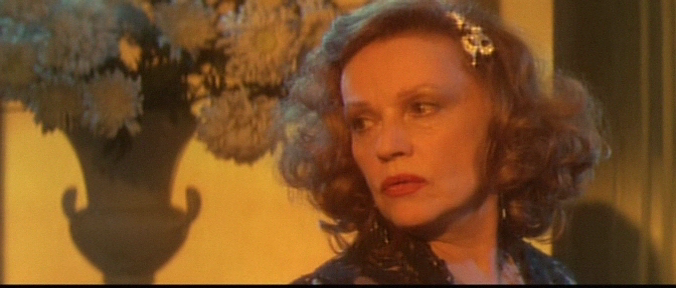
Jeanne Moreau as Lisianne

Franco Nero as Lieutenant Seblon


Latterly, after he had experienced belated success Fassbinder's productions got larger and more expensive; he was able therefore to use more well-known actors.  QUERELLE is a case in point: aside from Brad Davis, he got Franco Nero and Jeanne Moreau, which considering the nature of the film is some achievement.  Also involved are three actors from Peckinpah's CROSS OF IRON [1977], namely Burkhard Driest, Dieter Schidor and Roger Fritz.

Burkhardt Driest (R) as Mario


Dieter Schidor as Vic Rivette

Roger Fritz as Marcellin


Similarly, many of the crew were regular collaborators.  The two cinematographers Xaver Schwerzenberger and Josef Vavra had worked with him numerous times.  Co-editor Julie Lorenz worked in a wide range of capacities for Fassbinder, not least as his companion towards the end of his life.  The score is by Peer Raben who was another long-serving collaborator and who, incidentally, became Kaufmann's lover when the latter split with Fassbinder.  It says something, I'm not quite sure what, about the director that despite this he continued to involve both Raben and Kaufmann in his films.  As well as their acting roles, Driest co-wrote the script, Schidor was the producer and Fritz functioned as the stills photographer.